


Views: 0 Author: Site Editor Publish Time: 2026-01-08 Origin: Site


Power outages are no longer just a minor inconvenience; for many homeowners, they are a disruption to work, safety, and daily life. Whether you are looking to become energy independent or simply want a safety net during storms, a home battery system is the solution. Among the various sizes available, the 10kW battery (often referring to 10kWh capacity) has become the "Goldilocks" size—not too small for essentials, but not overwhelmingly expensive for the average household.
However, buying a battery isn't like buying a generator where you just pour in more fuel. You are dealing with a finite amount of stored energy. The most common question homeowners ask before investing is simple: how long will it actually keep the lights on?
The answer isn't a single number. It depends entirely on what you turn on, how efficient your system is, and the technology inside the battery. This guide breaks down exactly what you can expect from a 10kW system.
The duration a 10kw battery lasts depends entirely on your energy consumption. To visualize this, think of the battery as a tank of water and your appliances as faucets. If you open every faucet in the house, the tank drains quickly. If you only use a slow drip for drinking water, it lasts a long time.
Technically, a 10kWh (kilowatt-hour) battery can provide:
1,000 watts of power for 10 hours.
2,000 watts of power for 5 hours.
500 watts of power for 20 hours.
For the average home running essential circuits—such as a refrigerator, WiFi, LED lights, and charging phones—a 10kW battery typically lasts between 10 to 12 hours without solar recharging. If you are conservative with your usage, you might stretch it to a full 24 hours. However, if you attempt to run central air conditioning or an electric dryer, that same battery might drain in less than two hours.
To get an accurate estimate, you need to perform a load calculation. This involves adding up the wattage of the devices you intend to keep running during a blackout. It is important to distinguish between "starting watts" (the surge needed to turn a device on) and "running watts" (what it consumes continuously).
Once you know your total power consumption per hour, you can divide your battery capacity by that number to get your estimated runtime.
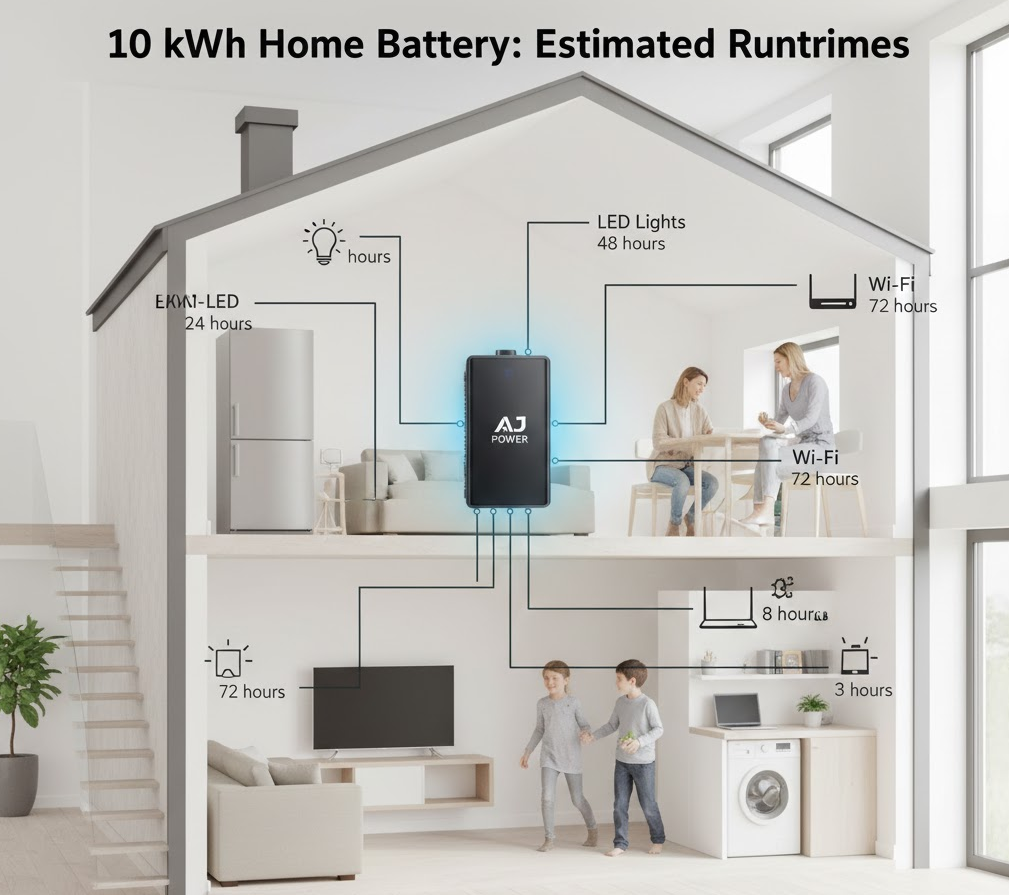
Here is a breakdown of how long a 10kWh battery can run common household appliances individually.
Appliance | Average Wattage (Running) | Estimated Runtime (10kWh Battery) |
|---|---|---|
LED Light Bulbs (10 bulbs) | 100W | 100 Hours |
WiFi Router & Modem | 20W | 500 Hours |
Refrigerator (Energy Star) | 150W | 66 Hours |
Laptop Charger | 60W | 166 Hours |
50-inch LED TV | 80W | 125 Hours |
Microwave | 1000W | 10 Hours |
Coffee Maker | 800W | 12.5 Hours |
Sump Pump (1/2 HP) | 1000W | 10 Hours |
Typical "Essentials" Bundle | ~800W - 1000W | 10 - 12 Hours |
Note: These figures assume a 100% efficient discharge, but real-world variables always reduce this slightly.
You might notice that in real-world scenarios, you rarely get exactly 10kWh of usable energy out of a 10kWh battery. Several technical variables eat into your power supply. Understanding these three factors will help you manage your expectations and your energy usage.
Depth of Discharge refers to the percentage of the battery that has been used relative to its total capacity. Not all batteries are created equal here. Old-school lead-acid batteries could only be discharged to about 50% without damaging them. This meant a 10kWh lead-acid battery only gave you 5kWh of usable power.
Modern Lithium Battery BMS 5kWh 10kWh 15kWh Rack Solar Home Energy Storage LiFePO4 Battery systems are far superior. They typically allow for a DoD of 80% to 100%. If you have a lithium system with 90% DoD, you have 9kWh of real, usable electricity.
Batteries store electricity as Direct Current (DC), but your home appliances use Alternating Current (AC). An inverter bridges this gap. The conversion process is not perfect; energy is lost as heat. Most high-quality inverters are about 90-95% efficient. This means for every 10kWh stored, you might lose 0.5kWh to 1kWh simply during the conversion process.
Batteries are chemically sensitive to temperature. Extreme cold slows down the chemical reactions, temporarily reducing capacity. Extreme heat can degrade the battery's lifespan over time. Keeping your battery for home energy storage in a temperature-controlled garage or basement ensures you get the maximum duration out of every charge.
Choosing between a 10kWh system and a larger setup involves capacity planning based on your specific backup needs. While 10kWh is the standard entry point, it isn't enough for everyone.
If you have a large family, live in an area with multi-day outages, or rely on electricity for heating and cooling, you may need to upsize.
Feature | 10kWh System | 20kWh System |
|---|---|---|
Best For | Essential loads (Lights, Fridge, WiFi). | Whole-home backup or heavy appliances. |
Duration (Avg Load) | 10-12 Hours. | 20-24 Hours. |
Heavy Appliance Use | Limited (Microwave or Coffee maker briefly). | Moderate (Can run A/C or Well Pump for limited periods). |
Solar Pairing | Pairs well with 3kW - 6kW solar arrays. | Needs larger solar array (8kW+) to recharge fully in one day. |
If you are unsure, many homeowners start with a modular rack-mounted system. This allows you to install 10kWh now and easily add another 5kWh or 10kWh module later if you find your backup needs increasing.
When shopping for a 10kw battery, you will likely encounter different chemical compositions. Today, LiFePO4 (Lithium Iron Phosphate) is widely considered the gold standard for residential storage.
Unlike older lithium-ion chemistries used in phones (which can be prone to overheating), LiFePO4 is incredibly stable and safe. Safety is paramount when installing a large energy device inside your home.
Furthermore, longevity is a massive advantage. For example, high-quality LiFePO4 batteries can offer over 8,500 lifecycles. If you cycle the battery once a day, that is more than 20 years of service life. This durability makes them a much smarter financial investment compared to cheaper alternatives that need replacing every 5 to 7 years.
For solar installers, energy integrators, and businesses looking to scale their operations, sourcing high-quality batteries is the biggest hurdle. The market is flooded with varying quality levels, making it difficult to guarantee reliability to end-users.
Finding power batteries wholesale requires looking for manufacturers who offer transparent specifications—like BMS (Battery Management System) protection, clear cycle life data, and communication compatibility with major inverter brands. Suppliers like AJ Power specialize in rack-mounted solutions that allow businesses to purchase reliable 5kWh, 10kWh, and 15kWh units that are scalable and easy to install.
A 10kW battery is a powerful tool for energy resilience, capable of keeping a home's essential devices running for 10 to 12 hours during a blackout. However, the exact duration depends heavily on managing your load consumption and the efficiency of the battery technology you choose. By opting for modern LiFePO4 systems and correctly calculating your wattage needs, you can ensure your home stays powered when the grid goes down.


